
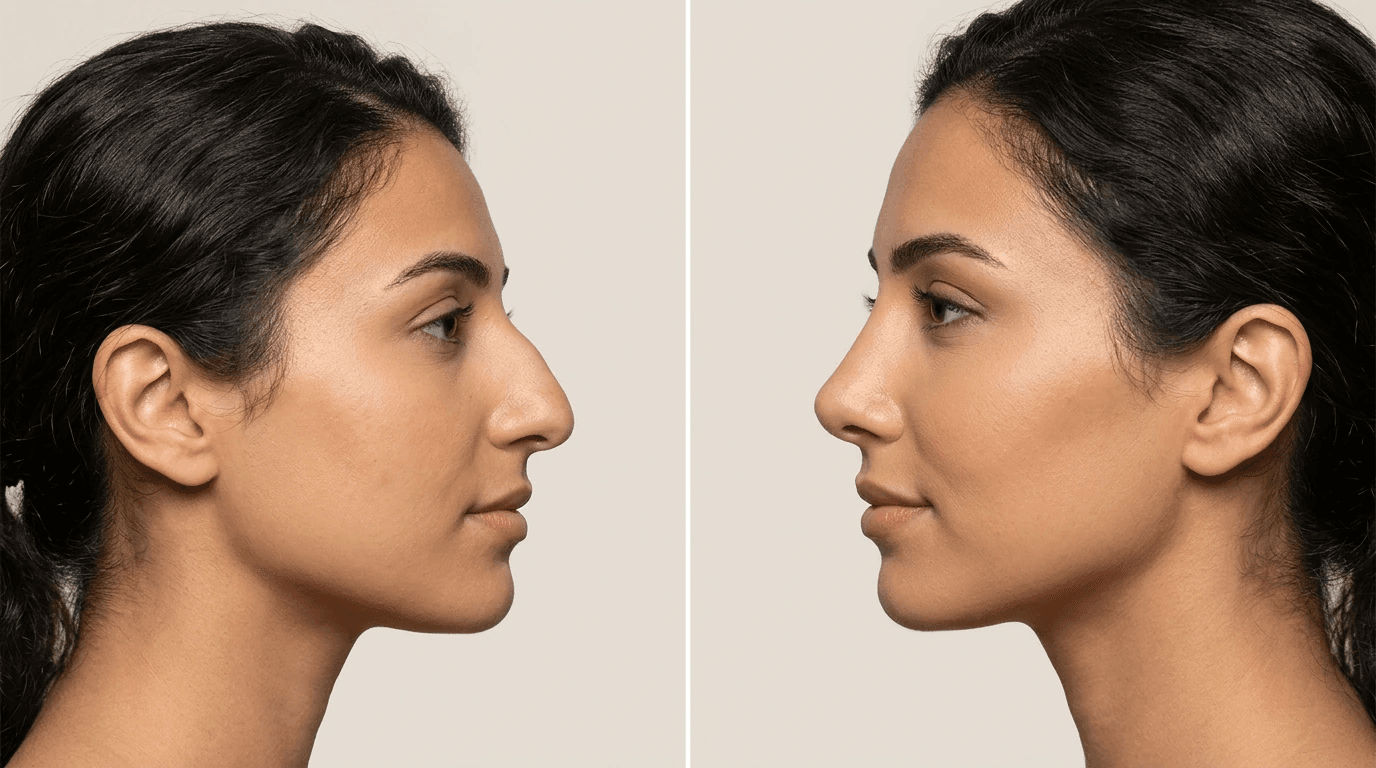
The European nose model: between natural looks and balanced beauty
In recent years, many rhinoplasty patients have moved away from overly upturned, exaggerated noses toward more natural styles; one of the most popular of these is the European-style nose.
In this type of surgery, the main goal is to correct nasal imperfections and harmonize the nose with the rest of the facial features, without the nose appearing unnatural or artificial.
In this article, in a specialist yet accessible way, we examine what European-style rhinoplasty is, its features, which face types it suits, how it differs from a 'doll nose' procedure, and finally, under what circumstances it can be the best choice for you.
What is European-style rhinoplasty? Definition and main features of this surgical style
European-style rhinoplasty refers to a style of rhinoplasty in which:
The nose has a very gentle curve (neither completely straight nor sharply curved like a doll nose)
The tip of the nose is slightly raised, but not exaggerated or overly upturned
The nostrils don't become visibly flared or open
The nose size is adjusted to be proportionate and natural relative to the face
The nose's respiratory structures (septum, nasal valves, etc.) are preserved or corrected as much as possible
With this style, the final result is usually designed so that if you saw the person for the first time, you wouldn't notice that their nose had been operated on — you'd simply see a more elegant, balanced, and attractive face.
The difference between European-style rhinoplasty and a 'doll' or exaggerated nose
Many patients ask this question during consultation:
"What's the difference between a European nose and a doll nose?"
Scientifically and aesthetically, these differences matter:
Nose angle and curve
In a doll nose:
The bridge's curve is usually pronounced and clearly visible.
The tip of the nose becomes very upturned.
The angle between the lip and nose may become more than normal.
In a European nose:
The nose's curve is gentle and natural, giving the face a soft, delicate look — not an exaggerated one.
The tip of the nose rises slightly, but still retains a natural feel.
Adjusting blood-thinning medications under the doctor's supervision
Proportion with the face
A doll nose is chosen especially for very small faces, or for faces seeking a 'noticeable change'; but on some faces, it can create a sharp, unnatural contrast.
The European nose model is designed more for people who want:
Their face to look refined, elegant, and natural
The shape of the nose to be in harmony with the forehead, lips, and chin
Others to notice only that their 'face looks better,' not that their 'nose was operated on.'
Breathing and nasal structure
In heavily exaggerated surgical styles, if not done correctly, the likelihood of structural weakness and airway narrowing increases.
In European-style rhinoplasty, when performed by an experienced surgeon:
There is greater focus on preserving or reinforcing the structure
Reduced likelihood of breathing problems
Controlled changes are made to the nasal skeleton and cartilage.
Which faces is the European-style nose suited for?
One of the most important points discussed in consultations at Dr. Sadighi's clinic is that this surgical style isn't suited to every face or every preference. Below, we examine a few important criteria.
Overall face shape
In general, European-style rhinoplasty is a good choice for these face types:
Elongated, oval faces
These faces harmonize very well with a balanced nose and a gentle curve.
Symmetric faces with relatively delicate features
People whose eyes, lips, and cheekbones are relatively delicate.
Faces where the jaw and chin aren't excessively weak or excessively large
In cases of chin disproportion, jaw surgery or a chin implant may sometimes be recommended at the same time, so the nose result also looks more attractive.
Nose type (bony or fleshy)
Bony noses with thin to normal skin
are the best candidates for European-style rhinoplasty, because the fine detail of changes made to the nasal skeleton shows very well in the final result.
Fleshy noses with thick skin
can still have the European style applied, but:
The final result is usually less refined-looking
The patient's expectations need to align with the reality of the nose's anatomy
Sometimes, instead of adding a strong curve, the focus is on controlled reduction and refining the tip of the nose.
Patient preference and expectations
European-style rhinoplasty is suited for people who:
Are looking for a natural, elegant, mature-looking face
Don't want their nose to look 'exaggerated' or 'doll-like'
Want a completely professional, balanced look in personal, work, and formal photos
Don't expect an 'unrealistic miracle' from the surgeon and value scientific facial proportion.
Benefits and limitations of the European-style nose
Benefits of European-style rhinoplasty
A natural, non-artificial appearance
Increased facial harmony rather than drawing attention to the nose
Suitable for professional, work, and formal settings
Can be combined with correcting a deviated septum or breathing problems
Reduced likelihood of dissatisfaction from the nose becoming 'too small' or 'too upturned'
Limitations and points to consider
For very fleshy noses, the result can't be as refined as on European faces with thin skin.
If you expect a very dramatic, showy change, this style may not be the ideal choice.
It requires precise design and the surgeon's experience in creating a gentle curve and preserving the nose's structure; not every surgeon performs this style to a consistent standard.
General steps of European-style rhinoplasty at Dr. Sadighi's clinic
At Dr. Alireza Sadighi's aesthetic clinic — a jaw, facial, and rhinoplasty surgeon — the process for European-style rhinoplasty is carried out in stages, scientifically:
1. Consultation and facial assessment
Detailed examination of the face from the front and profile
Assessment of nose shape, skin, septal deviation, and breathing function
Discussion of your expectations and preferences (natural, semi-exaggerated, European, etc.)
If needed, simultaneous assessment of the jaw and chin to achieve better harmony.
2. Designing the nose model suited to the face
Determining the appropriate degree of curve and angle for your face
Deciding on the final size of the nose tip, the width of the nasal bridge, and the nostrils
Coordinating the nose shape with the eyes, eyebrows, lips, and chin in the design.
3. Performing the surgery with a focus on preserving structure
Correcting a hump or bump on the nose
Shaping the nose tip while preserving or reinforcing the cartilage
If needed, correcting septal deviation and improving breathing
Using techniques that keep the nose's structure as strong and stable as possible.
4. Post-operative care and follow-up
Full explanation about taping, sleeping position, and cleaning the nose
Scheduling for removing the splint, taking out stitches, and periodic visits
Assessing the process of swelling reduction and the nose settling into shape over the following months.
Important aftercare following European-style rhinoplasty for a better result
For the result of European-style rhinoplasty to be beautiful and long-lasting, a few points are essential:
Avoiding impact to the nose, especially for the first few weeks
Sleeping on your back with a few pillows under your head during the first days
Avoiding heavy glasses for the first few weeks (per your surgeon's guidance)
Avoiding strenuous physical activity until cleared by your surgeon
Regular use of nose tape as instructed
Attending regular follow-up visits at the clinic
How much does European-style rhinoplasty cost?
The cost of European-style rhinoplasty depends on various factors, including:
Nose type (bony or fleshy)
Whether or not a deviated septum or accompanying breathing problems are present
The need for simultaneous chin or jaw corrections
A history of previous nose surgery (revision surgery)
For this reason, giving an exact figure without an in-person examination or consultation isn't professional or scientific.
At Dr. Sadighi's clinic, after a specialist assessment and a complete review of your nose and facial condition, the exact, transparent cost is provided.
Why is choosing the right surgeon critical for European-style rhinoplasty?
While the European nose model looks natural, it's technically very precise and delicate.
If the nose's curve is designed slightly too little or too much, if the angle of the nose tip changes too much, or if the cartilage structure isn't properly preserved, the final result can end up looking unnatural.
As a jaw, facial, and rhinoplasty surgeon with surgical experience in the jaw, face, and rhinoplasty fields, and having performed cosmetic surgeries in Tabriz and Tehran, Dr. Alireza Sadighi places special focus, in designing and performing European-style rhinoplasty, on: scientific facial analysis, preserving breathing function, and creating a natural, elegant shape that's proportionate to the whole face.
Summary: when is European-style rhinoplasty the right choice for you?
If:
You're looking for a natural, elegant nose, not a fully exaggerated one
You want a professional, serious look in work, academic, or formal settings
You'd rather have people notice your 'overall facial beauty' than 'the nose itself'
And you want your surgery performed by a surgeon who evaluates the face as a single unit (jaw, chin, nose, lips),
the European-style rhinoplasty model can be a suitable choice.
At Dr. Alireza Sadighi's aesthetic clinic in Tabriz and Tehran, before any decision, a thorough consultation and complete facial assessment are carried out first, to make sure this surgical style truly suits your face and preferences.
To book an examination with Dr. Alireza Sadighi, get in touch with us.
📍 Tabriz clinic – Valiasr
📍 Tehran clinic – Saadat Abad
📞 09120149500
📞 04133334539
📷 Instagram: Dr.sadighi.alireza
Frequently asked questions about European-style rhinoplasty
1. Is European-style rhinoplasty suitable for all nose types?
No. European-style rhinoplasty is best suited for bony noses with thin to normal skin. The principles of this style can also be applied to fleshy noses, but the result is usually less refined-looking. During the consultation, after examining your skin thickness and nose structure, you'll be told to what extent this style is achievable for you.
2. What's the difference between European-style rhinoplasty and natural-style rhinoplasty?
Natural-style rhinoplasty covers a broader range and may be done with no curve or a very slight curve. In the European nose model, a gentle curve and a slightly upturned tip are usually designed to make the face look more refined and elegant; however, the nose still keeps a natural appearance.
3. How long does the swelling last after European-style rhinoplasty?
Most of the swelling decreases in the first 1 to 2 months, but reaching the final shape of the nose usually takes 3 to 6 months. For fleshy noses, this time can be a bit longer. During this period, the healing process is carefully monitored through periodic clinic visits.
4. Does European-style rhinoplasty increase the risk of breathing problems?
If the surgery is performed by an experienced surgeon while preserving the nose's main structures, not only does it not increase the risk of breathing problems, but if a deviated septum or airway narrowing is present, these can also be corrected at the same time. At Dr. Sadighi's clinic, the nose's breathing function is one of the main priorities in designing and performing the surgery.
5. How is the cost of European-style rhinoplasty determined at Dr. Sadighi's clinic?
The cost is determined based on the nose type, whether or not there's been previous surgery, the complexity of the case (deviation, breathing problems, need for revision), and the city where the surgery is performed (Tabriz or Tehran). After an in-person examination or consultation, the final cost will be clearly communicated to you.
6. What do I need to do to book a consultation for European-style rhinoplasty?
To book an appointment at Dr. Alireza Sadighi's aesthetic clinic in Tabriz or Tehran, you can reach out via the phone numbers, WhatsApp, or the appointment form on the website. At your first session, your face will be fully assessed, and the most suitable rhinoplasty style (including the European model) suited to your face and preference will be recommended.