
Before deciding on jaw surgery (orthognathic surgery), many people search forums like Ninisite for real experiences:
"How much does it hurt?", "How long does the swelling last?", "Is the numbness normal?", "Will my face change a lot?", "Is the recovery long?"
These concerns are completely natural; but scattered (and sometimes contradictory) experiences become useful when paired with a reliable, science-based explanation.
In this article, in Dr. Alireza Sadighi's own words, we summarize the experiences commonly raised by patients in plain language and explain:
Exactly who jaw surgery is for,
What the common complications are and how they're managed,
What recovery usually looks like,
And why digital planning can increase the precision and predictability of the result.
What is jaw surgery (orthognathic surgery), and who needs it?
Jaw surgery, or orthognathic surgery, is a specialized surgery to correct skeletal irregularities of the upper jaw, lower jaw, or both. The goal isn't just appearance; this surgery can simultaneously:
Improve chewing function,
Correct bite and tooth-contact problems,
Reduce abnormal pressure on the jaw joint,
And improve the proportion and balance of facial features.
Common candidates for jaw surgery
A significantly protruding or receded upper/lower jaw
Misaligned teeth (poor bite) that orthodontics alone cannot correct
Clearly visible facial asymmetry
Functional issues such as difficulty chewing, certain speech difficulties, or pressure on the jaw joint
A final diagnosis is always made through a specialist examination plus imaging (such as CBCT).
Why do people ask so many questions about jaw surgery on Ninisite?
Because jaw surgery is both a major decision and one with a clearly visible effect on the face. The most common concerns seen in shared experiences are:
Pain after surgery
Swelling and bruising
Numbness of the lip/chin
Length of recovery and return to work/daily life
Concern about changes in appearance and the final result
Cost and treatment stages
Below, we address each of these honestly and scientifically.
Pain, swelling, and numbness after jaw surgery: what's the reality?
Pain after jaw surgery
Pain is usually controlled with prescribed medication. Many patients say "the pain was more tolerable than I expected," but experiences vary and depend on the type of surgery, individual pain threshold, and physical condition.
Swelling and bruising
Swelling in the first few days is normal and typically:
Increases most in the first 48 to 72 hours,
Then gradually decreases.
Following your doctor's recommendations (cold compresses, medications, appropriate diet, etc.) plays a major role in controlling swelling.
Numbness of the lip and chin
Temporary numbness (especially with certain lower-jaw surgeries) can occur, and in many cases improves over time. Its extent and duration depend on the type of surgery and the patient's neuro-anatomical condition.
Important: this is exactly where choosing an experienced surgeon and careful pre-operative planning matters most.
The role of digital methods in jaw surgery (why the result becomes more predictable)
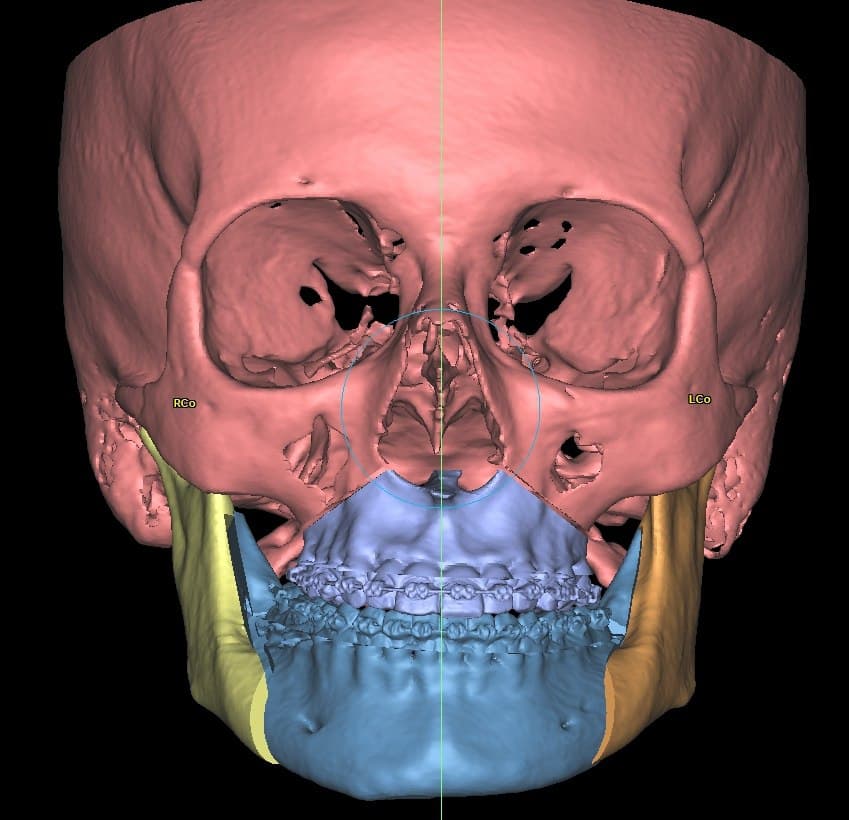
In jaw surgery, millimeters matter. Digital approaches help make pre-operative planning more precise and intra-operative execution more controlled.
3D scanning and digital design
With CBCT and 3D modeling, the jaw structure and tooth positions are examined precisely, allowing the surgical plan to be designed with high accuracy.
Outcome simulation
One of the biggest concerns is "how much will my face change?" Digital simulation helps the patient form a more realistic understanding of the treatment path.
Surgical guides
Patient-specific surgical guides can increase the precision of surgical execution and reduce error (at the treatment team's discretion).
To read more about digital surgery, you can see the NCBI study on digital surgery.
General stages of jaw surgery treatment, from consultation to recovery
1. Specialist consultation and assessment (examination + review of imaging)
2. Treatment plan (sometimes combined with orthodontics before/after)
3. Digital planning and preparation
4. Performing the surgery at a suitable medical facility
5. Post-operative follow-up and care + regular visits
For details on aftercare, also see this page:
Care after jaw surgery
Possible complications of jaw surgery and ways to reduce risk
No surgery is without risk; but with the right choice and proper care, risks can be reduced. Possible complications may include:
Swelling and bruising
Temporary pain
Temporary numbness
Temporary limitation in opening the mouth
The need for careful attention to diet and oral hygiene
Two key factors for reducing risk:
1. Careful pre-operative planning
2. Fully following post-operative instructions and attending regular follow-up visits
What factors determine the cost of jaw surgery in Tabriz?
Rather than a fixed number, it's more accurate to explain the determining factors:
The severity and type of irregularity (upper jaw, lower jaw, or both jaws)
The need for accompanying treatments (such as orthodontics)
The techniques and facilities used (including digital planning)
Where the surgery is performed and hospital costs
The surgeon's experience and expertise
An accurate cost estimate requires an examination and review of imaging.
Why choose jaw surgery in Tabriz with Dr. Alireza Sadighi?
If you're looking for the best jaw surgeon in Tabriz, Dr. Alireza Sadighi — with years of experience in jaw surgery using digital methods — is one of the top options for you. High patient satisfaction and a strong track record in this field reflect his skill and expertise.
Summary and booking a consultation
If, like Ninisite forum users, you're concerned about pain, recovery, or the final result, the best approach is to have a specialist evaluation rather than relying on scattered experiences, so your jaw condition, bite, and treatment path can be clearly determined.
To book an examination with Dr. Alireza Sadighi, please get in touch with us.
📍 Tabriz clinic – Valiasr
📍 Tehran clinic – Saadat Abad
📞 09120149500 | 04133334539
📷 Instagram: Dr.sadighi.alireza
🔗 Book an appointment online: https://dralirezasadighi.com/contact/
Frequently asked questions about jaw surgery
Is the result of jaw surgery predictable?
To a large extent, careful digital planning increases predictability; but the final result also depends on individual conditions and the body's healing process.
How long does recovery from jaw surgery take?
For many patients, recovery happens in stages: the first few days are harder, and the process improves gradually after that. The time to return to work depends on the type of surgery and physical condition.
Is jaw surgery only for cosmetic reasons?
No. In many cases, the main goal is correcting function and bite, and improved appearance follows as an important accompanying result.